[Here is the much awaited (by me at least) continuation of my Home Resource Use Audit for my lil’ Quiet Riot.]
As you’ve probably noticed, food is my thing. Partly because I think food is one of the areas of our lives where we have the greatest possibility for responsible action. Everyone eats, most of us eat a few times a day. Big things like your home’s electricity, water and heating fuel can seem impenetrable, but the changes that need to be made to our food system can be made in little chunks, millions of small decisions every day which add up.
Perhaps even more importantly, we stand to gain the most direct value from our efforts with food. Almost every more responsible food also offers dramatically better health for you and your family, not to mention just plain better eating. Though some of this is surely a personal bias– I love food. I love growing food, I love preserving food, I love cooking food, I love talking about food, I love looking at food, and I love eating food.
When it comes to making those every day changes, I think homemade food is the first step. Moving the preparation of your meals from factory to home kitchen is good for everyone involved. The next step is homegrown. Although lining your front steps with pots of lettuce has quickly become cliche in this new urban homesteading fad, I do think that growing your own is incredibly useful, even if the scale is tiny. As with anything else, doing it yourself is sobering. No amount of reading can teach you the truths about food production that one summer garden will teach you. Namely that it’s hard. When you consider the amount of work you put into each head of bug eaten lettuce, you will begin to understand the incredibility of the supermarket’s rows of perfect heads for $2 each. You will become more flexible to imperfection and more understanding of the high prices at the farmer’s market.
Most of us are not set up to grow a very significant portion of our food, and so sourcing ingredients is the next important step. I have been working on this for awhile, it’s a confusing topic. Local non-organic? Or organic from Whole Foods? What items are most eligible for the inevitable compromise of a low budget?
I did some research and detailed my own grocery decisions last year in this little series:
Responsible Consumerism: How to Make It Work
Putting Your Money Where Your Mouth Is: Part 1
Putting Your Money Where Your Mouth Is: Part 2
Going back over those posts I saw that I was only spending about $400/month on groceries. My average now is $5-600. Part of that is that we had a freezer and pantry full of wild game and fish brought from Alaska, and now I am buying all our meat at the farmers market (can’t afford fish), but I don’t think I spend more than $80-100/month on meat, the rest I fear is due to the ever increasing list of what we consider “essentials.” Juice for example, I used to buy once in a while as a treat, now it’s a staple. During this Riot, I hope to pare that list back down.
At any rate, on to that audit, right? I had piles of grocery store receipts saved from three (non-consecutive) months and a pretty good estimate for what I spend at the farmer’s market (I always go thinking I’m going to spend just $30, and almost always spend close to $40). Putting a dollar value on our eggs was easy, but I really pulled the garden vegetable dollar amount straight out of my ass.
I counted everything from Whole Foods as “industry organic.” Although they actually sell quite a bit of non-organic stuff (watch those labels!) I am pretty specific about my purchases, why pay Whole Wallet prices for the same stuff I can get at the regular grocery store?
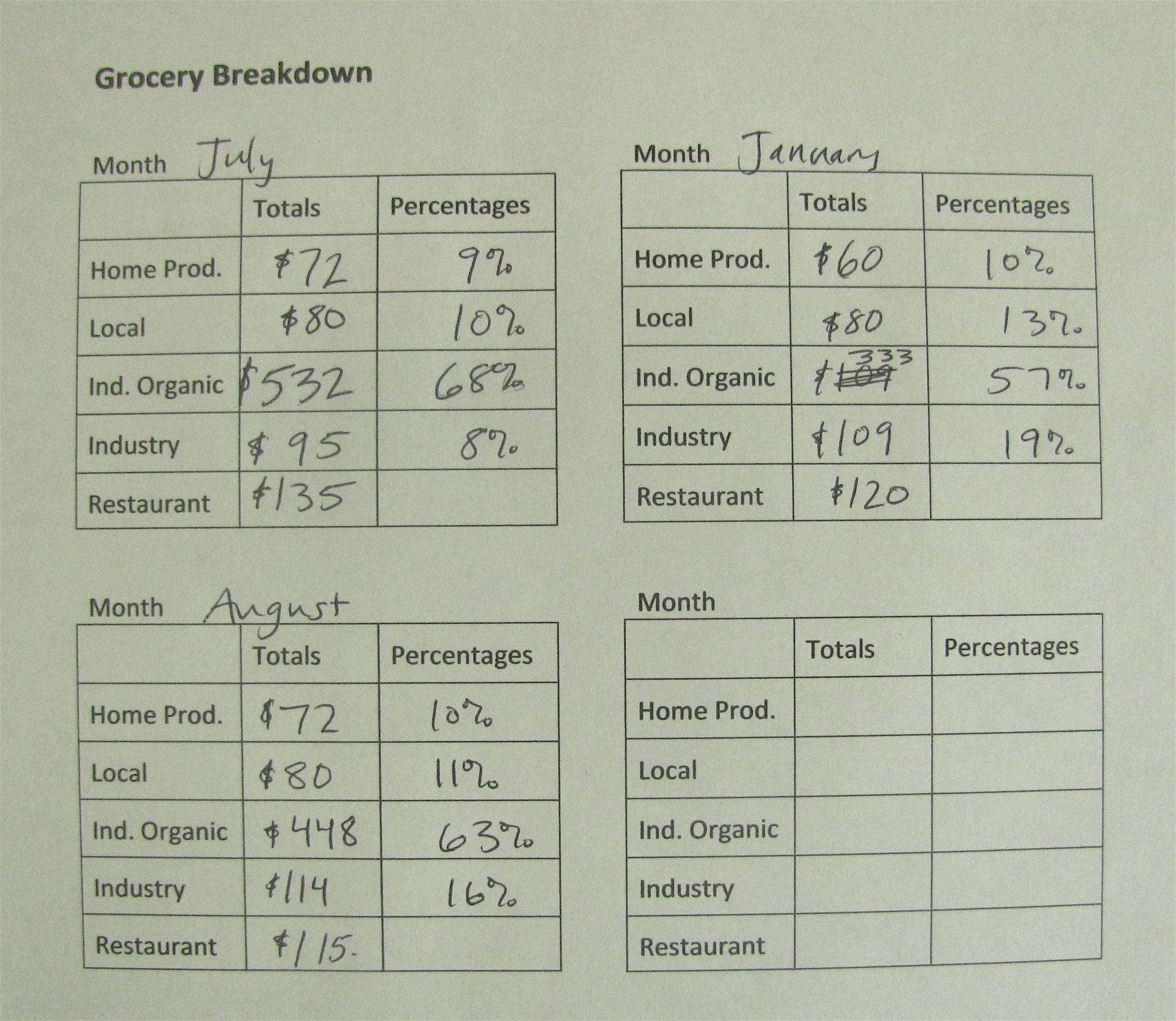
I didn’t add the restaurant expenses into the percentages, because much of what you pay for at a restaurant is service, which seems not applicable to this resource-use study. But leaving it out seems wrong too, especially since it’s most certainly industrial food. I think for the coming months, I will add it into the percentage calculation, but at one third the value. When you spend $15 on dinner, it’s probably not more than $5 worth of food, right?
So, as you can see, a little more than 60% of our diet is industrial organic from Whole Foods. All industry organic is not equal, by any means, and I have done some research. I buy almost exclusively Organic Valley dairy (dairy is a large portion of our grocery bill), based on this Cornucopia Institute report, I do believe Organic Valley has an honest organic standard, whereas I wouldn’t trust Horizon and the other biggies farther than I could throw them. OV’s milk says it’s from “Southwest Farms” which is at least moderately regional. I assume the rest of their dairy line, and everything else I buy from WF, has plenty of miles under it’s belt by the time I bring it home. As well as the copious packaging.
I often waffle back and forth between the local non-organic dairy from the farmers market, and the Organic Valley dairy. Because of having kids, I mostly settle on organic. Pesticides, and all toxins, accumulate in breast milk, and particularly concentrate in the fat. I believe butter is one of the most important things to buy organic. Especially when kids are involved.
However, there is a new vendor at our market, who is about to start selling (non-organic) milk in glass bottles, and I don’t think I can resist that. I hate those big plastic jugs piling up in my consciousness. As I mentioned in an earlier post, I have been buying plain old crap industry cheese and I intend to switch to farmer’s market cheese even though it’s (deep breath) $12/pound. And I don’t want to hear any more comments from any readers in Wisconsin who can get 5 kinds of local cheese for $6/lb. Go away from me with that information.
As far as the garden goes, the flush season is upon us here in southern Louisiana but I am sadly behind the curve. Remember my earnest decision to actually follow my garden plan this season? Well, given the events of September 2011 in our particular household, I missed the boat. Late September and early October is the time to be in the garden in our climate, and I was anywhere but. I killed a whole flat of starts, and was too late with planting the next. I will still have a fine garden this fall, I’ve got green beans, cucumbers, peppers and collards coming on now, and broccoli, cabbage and beets on the horizon. But I have missed my chance for peas, potatoes, brussell sprouts, onions, leeks and carrots. Thankfully, “spring” planting starts here in January (!!!), so I have one more chance at this New Orleans gardening business.
Thank goodness.


Penny for your thoughts…?